Early-Stage AI Strategy
Turning Assumptions Into Direction
In late 2025, I was brought into a confidential early-stage AI initiative operating in a highly regulated
European market. The product details, technology, and company identity remain fully under NDA.
This case study focuses exclusively on my work, my process, and the strategic contribution.

Context
A founder in a highly regulated European market approached me during the early development of an AI-driven product.
The business model was promising, but core elements such as narrative, positioning, user insight, and strategic direction were
still undefined.
This case study focuses on my contribution and process, not the confidential product itself.
The Challenge
Early AI products don’t fail because of the technology.
They fail because of unclear narrative, lack of proof, and misaligned assumptions.
When I joined the project, the team needed clarity around:
What problem we are truly solving
Why now
Who the product serves
What makes it believable
How to gain trust in a regulated environment
How to turn early assumptions into a coherent direction
Objective
Build a strong strategic foundation within three weeks by:
Aligning the founder’s vision
Validating early assumptions
Creating brand clarity
Surfacing user signals
Structuring product value
Mapping opportunities
Crafting a narrative suitable for investors and early adopters
My Role
Product & Brand Strategist (Consultant)
Strategy
Research
Narrative
Positioning
Product framing
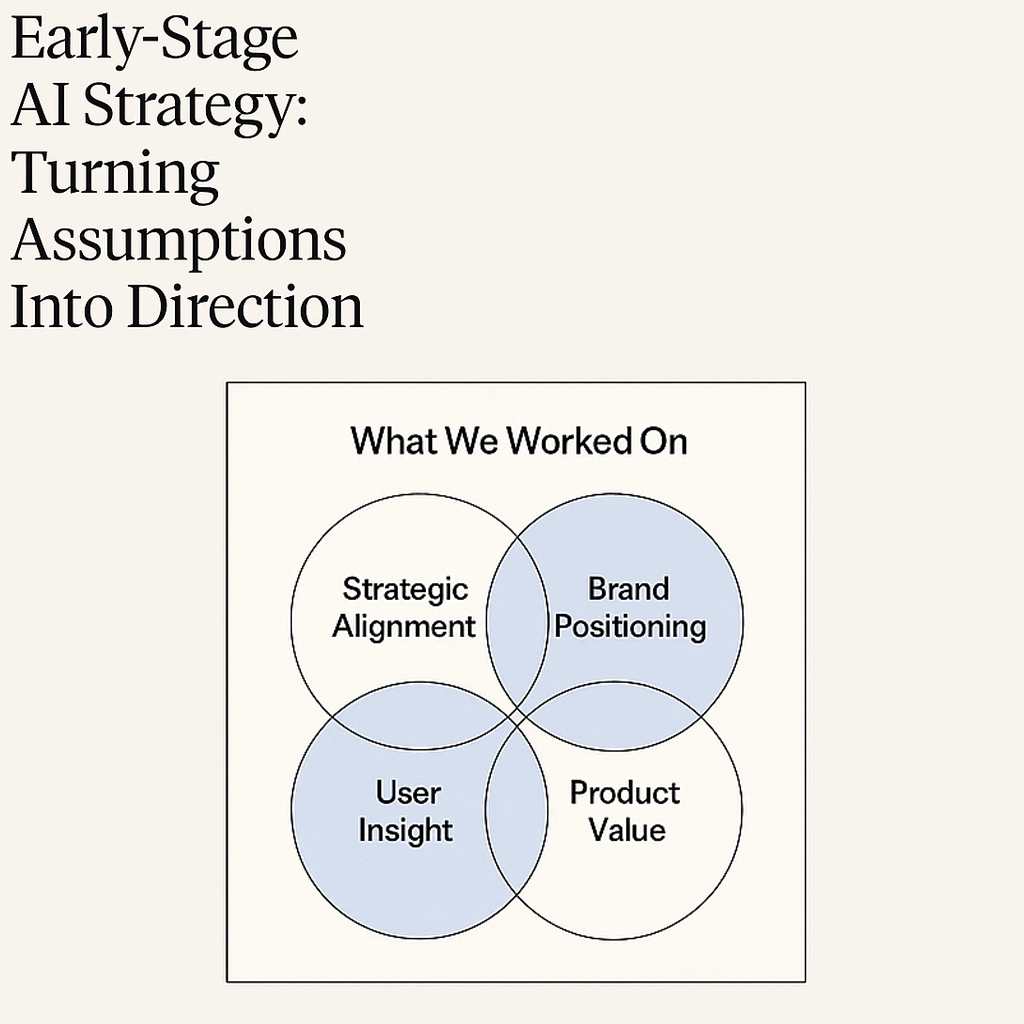
What We Worked On
A. Strategic Alignment
Clarified the founder’s mental models, surfaced assumptions,
and translated fragmented ideas into a cohesive vision.
B. Market & Ecosystem Intelligence
Mapped competitors, regulatory forces, adoption barriers, and opportunities to position the product correctly.
C. Brand Positioning & Value Pillars
Defined the product’s strategic identity:
promise
emotional value
trust signals
differentiation
purpose
why it deserves to exist
D. User Insight Through a Targeted Survey
Designed and analyzed a survey for decision-makers in regulated industries to measure:
fears
readiness
perceived risk
buying signals
adoption conditions
E. Product Value & Differentiation Architecture
Structured the product’s core value and what makes it unique, credible, and needed.
F. Roadmap & Opportunity Definition
Outlined short-term priorities and long-term expansion paths aligned with user needs and investor expectations.
G. Investor Narrative Structure
Designed the strategic flow for:
problem → insight → proof → opportunity → product direction → vision.
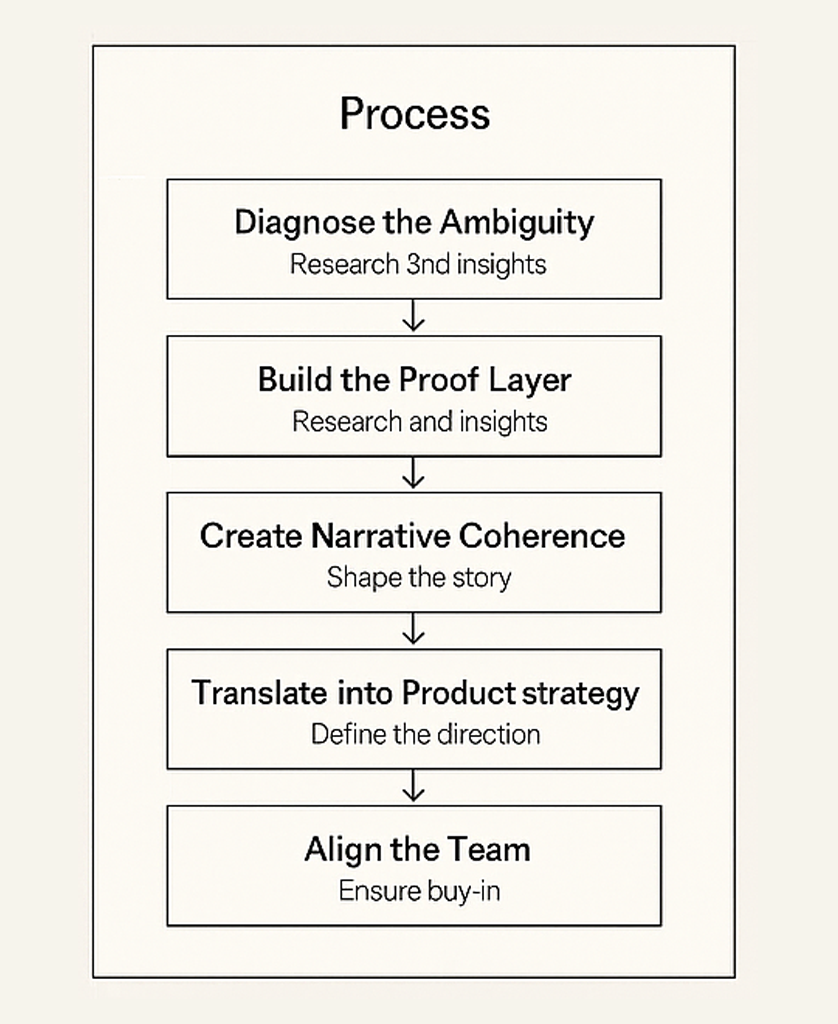
Process Overview
A simple, repeatable framework I used:
1. Diagnose the Ambiguity
Identify conflicting assumptions, gaps, blind spots, and missing clarity.
2. Build the Proof Layer
Use market insights, user signals, and strategic analysis to validate direction.
3. Create Narrative Coherence
Connect brand, product, and user value into a story that people understand, trust, and remember.
4. Translate Into Product Strategy
Define positioning, value pillars, early product direction, and roadmap framing.
5. Align the Team
Ensure the founder feels confident, grounded, and able to articulate the vision clearly.
Impact
The founder described the work as transformative,
noting that it provided:
clarity
confidence
a structured path forward
alignment around the product’s purpose
a believable narrative for investors
renewed energy and momentum
Loose ideas became direction.
Direction became confidence.
Confidence became possibility.